Zbay sends messages over a peer-to-peer network, using the privacy-preserving, censorship-circumvention tool Tor to connect to other peers.
Where apps like Slack, Discord, Signal and Element rely on central servers, Zbay syncs messages directly from other community members.
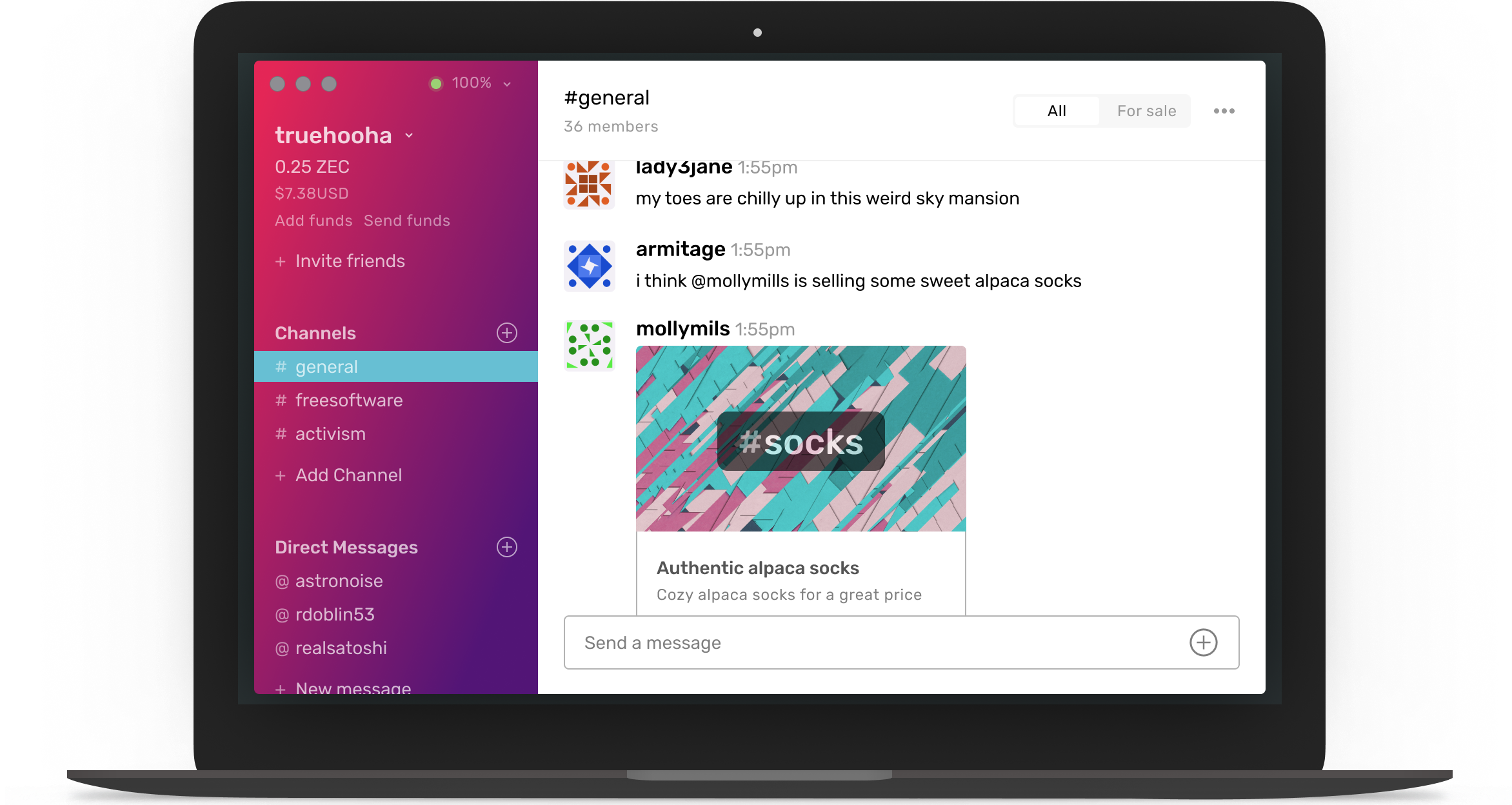
You can buy and sell things on Zbay, privately, with Zcash.
With most cryptocurrencies, such as Bitcoin, third parties can see who paid who. But Zcash makes this much more difficult, if not impossible, protecting your privacy. Zbay has a Zcash wallet built in, and you can send Zcash to any Zbay user.
In Zbay, not even usernames and user accounts rely on our servers. The makers of Zbay do not control who has a Zbay account, or what you do with your account.
Even if Zbay was ever forced to censor users, any developer could fork Zbay (that is, modify it and offer a competing version) to remove the censorship.
Zbay is free and open source software, so independent researchers will be able to verify that Zbay does what it claims.
If Zbay changes in an annoying or unethical way, any developer in the world can change Zbay’s code and publish a better version—and you could easily move your username, data, and messages to that new version.
Rather than building our own peer-to-peer network from scratch, we use established technologies like Tor, libp2p, and Zcash, since these tools are improving constantly, independent of our team.
We use familiar, cross-platform technologies like Node, Electron, and React, so that Zbay will be as easy as possible for any developers who disagree with our approach to understand, modify, redistribute, and maintain.